Events


We study inter-individual differences in executive and socio-emotional functioning across the lifespan,
with implications for developmental science and legal psychology.

Upcoming Events

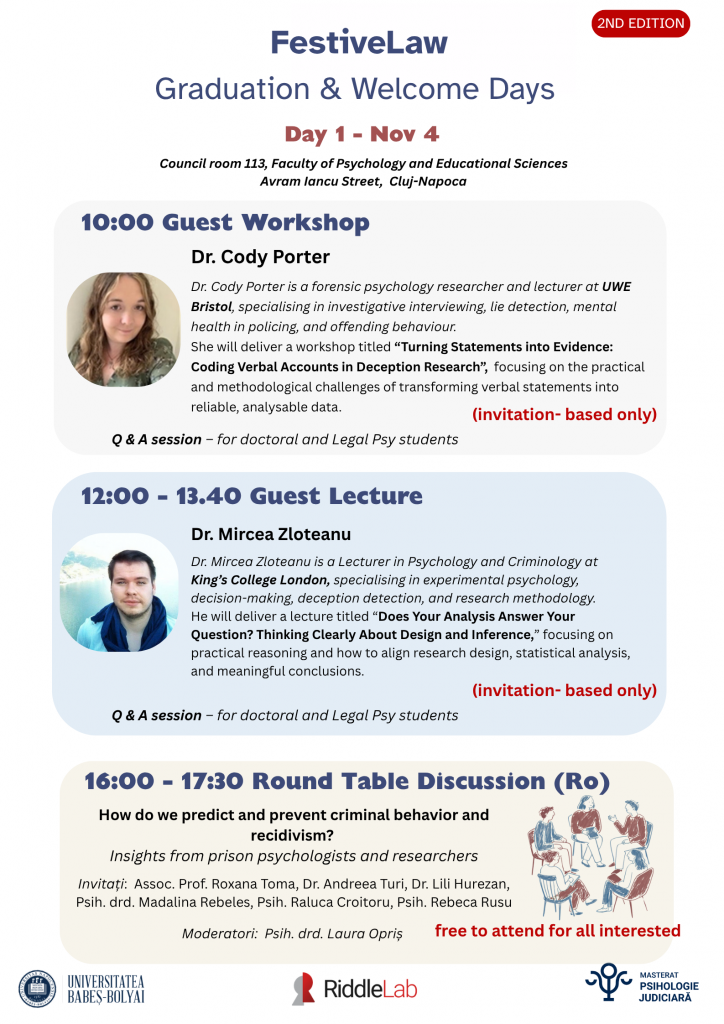
DAY 1, WEDNESDAY, NOVEMBER 4

1. Turning Statements into Evidence: Coding Verbal Accounts in Deception Research

10:00–11:40 

Speaker: Dr. Cody N. Porter

Abstract

Turning Statements into Evidence: Coding Verbal Accounts in Deception Research. Verbal statements are a rich source of information for researchers studying investigative interviewing and deception, but turning what someone says into analysable data involves a series of important methodological decisions. This workshop will examine the process of coding verbal statements in deception research, from deciding what constitutes a theoretically meaningful feature through to developing coding schemes, assessing reliability, and interpreting coded data. Drawing on examples from research on information elicitation and verbal cues to deception, the session will consider the practical challenges involved in moving from complex accounts to quantitative evidence, including how apparently simple coding decisions can influence the conclusions researchers draw. 

Meet our speaker: https://people.uwe.ac.uk/Person/CodyPorter

2. Does Your Analysis Answer Your Question? Thinking Clearly About Design and Inference

12:00–13:40

Speaker: Dr. Mircea Zloteanu

Abstract

Statistical analyses do not exist independently of the questions we want to answer. Yet, researchers often begin with a design or familiar statistical test and only later consider precisely what question the resulting analysis addresses. This workshop will explore how to move coherently from a research question, through study design and measurement, to an appropriate statistical model and defensible inference. Using examples from experimental and forensic psychology, we will consider common mismatches between questions and analyses, the importance of identifying the quantity or effect we actually want to estimate, and how different analytical choices can subtly change the question being answered. The emphasis will be on practical reasoning rather than any single statistical technique, with the aim of helping researchers make their analyses better reflect the claims they ultimately want to make.

Meet our speaker: https://www.kcl.ac.uk/people/mircea-zloteanu

3. Roundtable with Practitioners: How Do We Predict and Prevent Criminal Behavior and Recidivism? Insights from Prison Psychologists and Researchers (in Romanian)

16:00–17:30 

We are bringing together prison psychologists and researchers for an open discussion, exploring the challenges of risk assessment, prevention, and rehabilitation.

Discussants:

  • Assoc. Prof. Roxana Toma
  • Dr. Andreea Turi 
  • Dr. Lili Hurezan
  • Psih. drd. Madalina Rebeles
  • Psih. Raluca Croitoru
  • Psih. Rebeca Rusu

Moderator: Psih. drd. Laura Opriș 

———

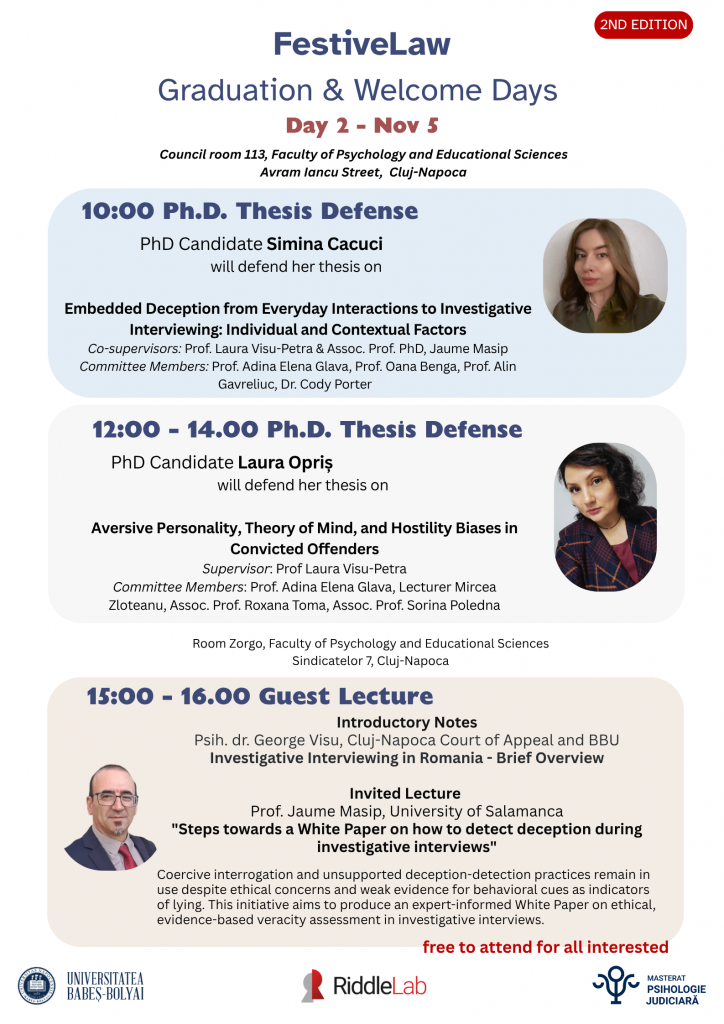
DAY 2, THURSDAY, NOVEMBER 5

Two Doctoral Defenses & A lecture on Advancing Investigative Interviewing

Location for the first part of the day (Nov 5th): Council Room, Avram Iancu

10:00–12:00 

1. PhD Thesis Defense: PhD candidate Simina Cacuci

Embedded Deception from Everyday Interactions to Investigative Interviewing: Individual and Contextual Factors

Abstract:

The thesis investigates truthful and deceptive information at the interplay of individual and contextual factors in daily interactions and investigative interviewing settings. The first four studies of the thesis examine the prevalence of truthful, deceptive, and mixed communication using the daily diary method. Individual factors such personality traits (dark and bright) and attitudes towards lying were explored together with contextual (medium of communication) and pragmatic factors (believability, planning, seriousness of consequences). Expanding on the work of DePaulo et al., (1996), an additional measure of „embedded deception” was introduced, looking at the mix of truthful and deceptive information included in an interaction. The last studies of the thesis focused on the interviewing-related factors. One study addressed the attitudes towards interviewing strategies and verbal cues of deception among Romanian police officers. A second one explored truthful and deceptive statements provided during a suspect mock interview in face-to-face and remote settings. Subsequently, personality traits were explored in relation to people’s use of deceptive strategies. Grounded in several theories of deceptive communication, the current work tests an explicit framework in which individual and contextual factors are considered together in the production of embedded deception and in the pathway from everyday lying to deceptive statements in the investigative interview.

PhD Defense Committee:

Chair: Professor Adina Elena Glava, PhD, Babeș-Bolyai University, Cluj-Napoca

Co-supervisors: Professor Laura Visu-Petra, PhD (Babeș-Bolyai University, Romania) & Associate Professor, PhD, Jaume Masip (University of Salamanca, Spain)

Committee:

  • Prof. Oana Benga (Babeș-Bolyai University, Cluj-Napoca)
  • Prof. Alin Gavreliuc (West University of Timișoara, Romania)
  • Assoc. Prof. Cody Porter (University of West of England, Bristol, UK)

12:00–14:00 

2. PhD Thesis Defense: PhD candidate Laura Opriș

Aversive Personality, Theory of Mind, and Hostility Biases in Convicted Offenders

Abstract:

The thesis explores the psychological mechanisms underlying aggressive and persistent criminal behavior by integrating various constructs such as aversive personality dimensions, theory of mind, hostility biases, aggression, and recidivism into a cohesive explanatory framework. It includes four original studies that delve into aversive personality traits, particularly the Dark Factor of personality (Moshagen et al., 2018) and its associated Dark themes (Bader et al., 2021), alongside socio-cognitive skills among convicted individuals. This investigation contributes to a deeper understanding of how undesirable personality traits influence the interpretation of others’ thoughts and intentions, ultimately leading to a predictive model for criminal behavior and its persistence. Furthermore, the proposed extension of the CHB model (Computations of the Hostile Biases; Smeijers et al., 2019) provides an explicit framework in which personality predispositions and socio-cognitive abilities are jointly considered in the decoding of social information and in the pathway toward aggression and criminal behaviour.

PhD Defense Committee:

Chair: Prof. Adina Elena Glava, PhD, Babeș-Bolyai University, Cluj-Napoca

Doctoral Supervisor: Prof. Laura-Alexandra Visu-Petra, PhD, Babeș-Bolyai University, Cluj-Napoca

Members:

  • Lecturer Mircea Zloteanu, PhD, Institute of Psychiatry, Psychology & Neuroscience at King’s College London (London, UK)
  • Associate Professor Roxana Toma, PhD, West University of Timișoara
  • Associate Professor Sorina Poledna, PhD, Babeș-Bolyai University, Cluj-Napoca

3. Investigative interviewing news 

Location: Zorgo room, Sindicatelor Street, no. 7

14:45–15:00 

Introductory Notes

Psih. dr. George Visu, Cluj-Napoca Court of Appeal and BBU

Investigative Interviewing in Romania – Brief Overview

15:00–16:00 

Invited Lecture

Prof. Jaume Masip, University of Salamanca

Steps towards a White Paper on how to detect deception during investigative interviews

Abstract:

Coercive interrogation and unsupported deception-detection practices remain in use despite ethical concerns and weak evidence for behavioral cues as indicators of lying. This initiative aims to produce an expert-informed White Paper on ethical, evidence-based veracity assessment in investigative interviews. Deception researchers were surveyed about promising and discredited techniques. Responses informed a two-day meeting involving 13 deception researchers, two legal scholars, and two experienced police investigators. The panel identified several approaches with empirical support, including the Strategic Use of Evidence Technique, the Verifiability Approach, the Unanticipated Questions Approach, the Asymmetrical Information Management Technique, and the Devil’s Advocate Approach. However, accuracy remains limited, independent replication is often lacking, and ethical or practical concerns may constrain use, particularly with vulnerable interviewees. Behavior Analysis Interview, synergology, Sapir’s SCAN technique, and judgments based on nonverbal cues (including micro-expressions) are considered unsupported or unreliable. Coercive and pseudoscientific practices should be replaced with trained, evidence-informed interviewing.

—–

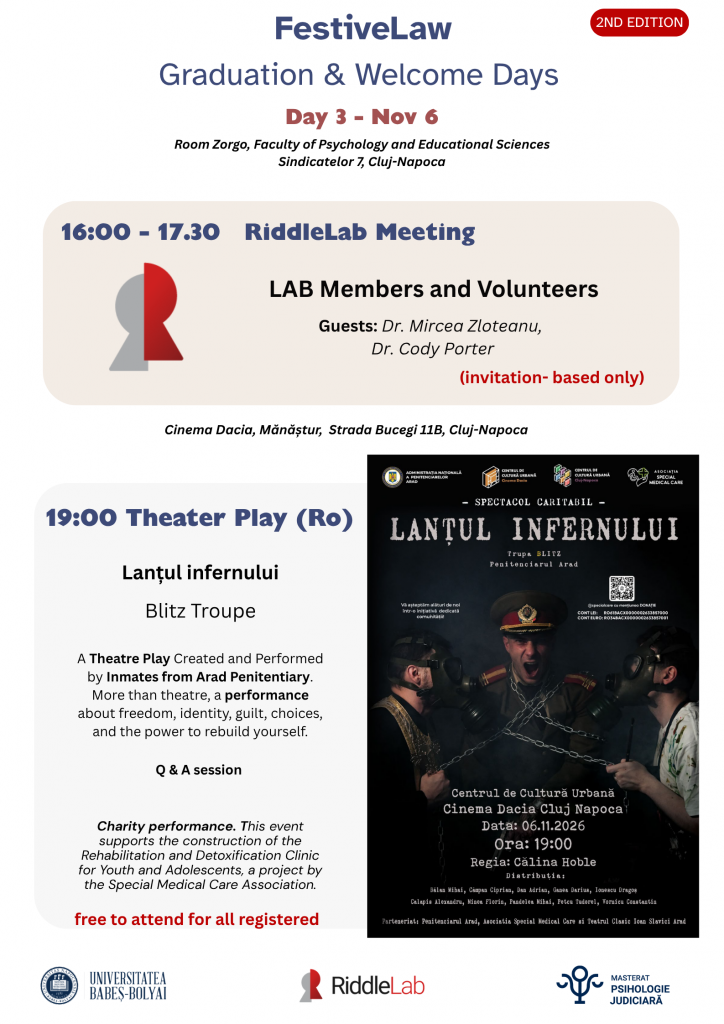
DAY 3, FRIDAY, NOVEMBER 6

1. RiddleLab Meeting

Location: Zorgo room, Sindicatelor Street, no. 7

16:00 – 17:30

We are excited to organize a meeting for our lab, dedicated to our members and volunteers, joined by two special guests: Dr. Mircea Zloteanu & Dr. Cody Porter.

This gathering is an opportunity to exchange ideas and strengthen our research community!

2. Theater Evening

Location: Cinema Dacia, Mănăștur, Cluj-Napoca

19:00

We will conclude FestiveLaw with a very special event: a theatre performance conceived and performed by incarcerated individuals from Arad Penitentiary.

This performance is open to the public! ✨ 

Past Events

The impact of child abuse and family violence on children.

Understanding and working with men who use violence in their intimate relationships.

Cluj, Romania, Sunday, 12 October, 10:00 – 17:00

 Dr. Ron Frey

Dr. Ron Frey is a psychologist who has worked in the field of family violence and child abuse for the past 47 years. He has lectured in developmental psychology, human sexuality, gender and psychology, and trauma at QUT for the past 34 years, and acted as an adjunct senior researcher at the Tasmanian Institute of Law Enforcement Studies, University of Tasmania, for the past eight years. 

Whilst at QUT, Dr. Frey worked with children living with violence and their families at a specialist counselling service for 11 ½ years, and served on the board of directors of DV Connect, the state-wide emergency crisis service for victim/survivors for ten years, and wrote the best practice guidelines for lawyers and courts interacting with children living in violent homes for the State of Queensland.  

He also assessed over 750 offenders for all levels of the Queensland courts.  Since re-locating to Tasmania, Dr. Frey has also evaluated the Tasmanian child protection system, developed parenting and counselling programs for families where family violence occurs, and has been responsible for introducing trauma-informed care across multiple social service programs run by Hobart City Mission.  

He also developed the workshop, ‘Working with Men who Use Violence’ for the Australian national DV Alert program and has personally delivered this program at over 100 locations around Australia. 

Organizers:

Legal Psychology Master, Dept. of Psychology, Babeș-Bolyai University (masterjudiciara@psychology.ro)

Centrul pentru atașament ACORD (Reprezentant: Andreea Peca 0742019045)

Numere de contact pentru informații curs: Ionel Maria Ștefania 0743238081, Oana Budacu 074204218


Poster Credit: Psih. Teona-Maria Coșa. Image Credit: Anna Shwets/Pexels, Timur Weber/Pexels.  

PROGRAM

Morning session 10 -12

An introduction to the impacts of child abuse and family violence on children in a lifespan perspective

What is trauma, and what is child trauma?  What makes abuse or neglect traumatic?


How common is child trauma?


The developmental impacts of abuse, neglect, and living in atmospheres of fear.

    Childhood trauma and the Western diagnostic system of mental disorders


How can childhood trauma last a lifetime

    Attachment and childhood trauma

    Trauma as inheritance


How does exposure to childhood trauma present in childhood?


Working with adult survivors of childhood trauma 


Keeping the father visible when working with children exposed to family violence


12 -13 Break

Afternoon session 13 -17

A.     Understanding men who use family violence – 13 -14.30

Distinguishing between a user of family violence and a male victim of his partner’s violence

Characteristics of abuse stemming from trauma vs. abuse stemming from entitlement

Men and micro-aggression and micro-humiliation

Reactions of guilt and shame

The intersection between shame and narcissism; working with men who have narcissistic tendencies

14.30 – 15  Coffee Break

B.     Working with men who use family violence – 15 -17

·       Why include the PUV (person using violence)

·       Safety and risk of doing this work to the victim/survivor and ourselves.

·       Systems accountability (punitive, shame), Internalised accountability

Balancing risk and humanity as the overall framework for counselling (Scaia, 2024)

Why safe engagement is the base line of all intervention for men using family violence

·       Why safety is critical to learning, and connection.

How to avoid collusion (missing risk)

·       Tools/resources: signposting, contracting, shaping/reshaping, re-contracting, normalising

How to avoid shame; developing narratives of hope (missing humanity)

·       Some practical exercise used with men to shift feelings of shame towards feelings of guilt and to build a hopeful narrative for change.

·       Nathanson’s compass of shame and polyvagal theory

Using parenting as a possible leverage for change; the ‘hook’.

The three leverages of change (Velonis et al, 2018): realising the impact on his family, recalling his own reaction to abuse in his childhood, going to guilt instead of shame

What kind of intervention works best for which men? Understanding ‘typologies’ of men who use violence

Individual counselling

Safety planning with men

·       Collaboration with men in developing a safety plan

Common reactions to working with men who use violence which impact on the mental health of the counsellor

·       Fear or harm to self

·       Anxiety

·       Transference (your dream)

·       Hopelessness/helplessness/cynicism

·       I will put women and children at risk

Organizers:

Legal Psychology Master, Dept. of Psychology, Babeș-Bolyai University (masterjudiciara@psychology.ro)

Centrul pentru atașament ACORD (Reprezentant: Andreea Peca 0742019045)

Numere de contact pentru informații curs: Ionel Maria Ștefania 0743238081, Oana Budacu 074204218   


JUSTAPPLY - (Justice & Applied Psychology) Symposium


27 NOIEMBRIE – IP1, Institutul de Psihologie, Republicii 37

12-13.30: Workshop: Planifică pentru eșec: Rezultate nesemnificative și testarea pentru “niciun efect”, Dr. Mircea Zloteanu
14-16: Workshop: Open Science: O scurta introducere si modalități simple de utilizare, Dr. Ștefana Juncu

4 DECEMBRIE – Sala Mărgineanu, Sindicatelor 7

12.00-12.45: Recunoașterea fețelor – Aplicații în psihologia judiciară, Dr. Ștefana Juncu
13.00-13.45: Teoria Detecției Semnalului (Signal Detection Theory – SDT) – Aplicații în psihologia judiciară, Dr. Mircea Zloteanu

Pauză

16-16.30: Rezultate Concurs Master Psihologie Judiciară “Pitch your thesis idea”
16.30-18: Prezentari cercetare RiddleLab

INVITAȚI

Dr Stefana Juncu

Senior lecturer in Forensic Psychology, University of Portsmouth. 


Ștefana și-a finalizat doctoratul cu finanțare ESRC la Universitatea din Portsmouth în 2022 și de atunci face parte din echipa academică a Departamentului de Psihologie. Cercetarea sa de doctorat s-a axat pe găsirea unor modalități de îmbunătățire a utilizării apelurilor privind persoanele dispărute, prin analizarea efectelor tipului de imagini și ale tipului de informații scrise incluse în aceste apeluri. Studiile ei actuale se concentrează pe îmbunătățirea recunoașterii fețelor în diferite contexte de investigații criminalistice. În special, cele mai recente studii a analizat modalitățile de evaluare a prejudecăților (eng. Biases) în timpul procedurilor de identificare a martorilor oculari și efectul variațiilor intra-individuale asupra memoriei prospective a persoanelor.

Dr Mircea Zloteanu

Senior lecturer in Experimental Psychology, Kingston University, UK.


Mircea este un cercetător în psihologie experimentală, interesat de emoții, judecată în situații de incertitudine și depistarea minciunilor. Studiază diferențele de judecată și percepție, efectele contextului asupra acurateței și prejudecăților, producerea expresiilor faciale înșelătoare și îmbunătățirea practicilor de intervievare judiciară. Recent, proiectele lui se axează pe meta-cercetare și meta-psihologie, cu accent pe metode, statistici și știința deschisă (open science). De asemenea, Mircea este psiholog autorizat de Societatea Britanică de Psihologie (BPS) și membru al Asociației Americane de Psihologie (APA).

PROGRAM EXTINS


27 NOIEMBRIE – IP1, Institutul de Psihologie, Republicii 37

12-13.30: Workshop: Planifică pentru eșec: Rezultate nesemnificative și testarea pentru “niciun efect”; dr. Mircea Zloteanu

Workshopul „Planifică pentru eșec: Rezultate nesemnificative și testarea pentru niciun efect” abordează importanța testelor de echivalență (Equivalence Tests) pentru evaluarea corectă a rezultatelor nesemnificative, oferind o modalitate de a determina dacă efectele sunt suficient de mici pentru a fi considerate neglijabile. Veti învăța cum să folosiți aceste teste în planificarea studiilor, inclusiv în analiza puterii statistice (power analysis), determinarea dimensiunii eșantionului (ROPE range) și a dimensiunii efectului (Smallest Effect Size of Interest). De asemenea, veți avea acces la coduri R și exemple aplicative, pe care le puteți încerca cu date din propriile cercetări.

14-16: Workshop: Open Science: O scurta introducere si modalități simple de utilizare – Dr. Ștefana Juncu

În ultimul deceniu s-a înregistrat o creștere demonstrabilă a promovării și adoptării cercetării deschise (open science) într-o multitudine de discipline. Cercetarea deschisă include o serie de practici privind desfășurarea cercetării (de exemplu pre-registration) și comunicarea rezultatelor acesteia (de exemplu, publicarea open access). În timp ce organismele de finanțare și revistele pun din ce în ce mai mult accentul pe cercetarea deschisă, poate fi generator de confuzie să începi să aplici cercetarea deschisă. În această sesiune voi discuta foarte pe scurt întrebările „Ce” este cercetarea deschisă și „De ce” ar trebui să vă implicați în acest subiect. Cea mai mare parte a workshop-ului va avea un accent practic, cu activități orientate pentru a vă sprijini în „Cum” vă puteți angaja în practicile de cercetare deschisă (tips and tricks despre pre-registration, open access etc.)

4 DECEMBRIE – Sala Mărgineanu, Sindicatelor 7

12.00-12.45: Recunoașterea fețelor – Aplicații în psihologia judiciară, Dr. Ștefana Juncu

Această prelegere explorează rolul esențial al recunoașterii faciale în psihologia judiciară, concentrându-se pe aplicarea sa în investigațiile criminalistice. Vom examina mecanismele psihologice și cognitive care stau la baza identificării faciale, acuratețea identificărilor martorilor oculari și construcția procedurii de identificare. Apoi, voi discuta despre o altă aplicație a cercetării privind recunoașterea facială pentru anchetele privind persoanele dispărute și infractorii căutați.

13.00-13.45 – Teoria Detecției Semnalului (Signal Detection Theory – SDT) – Aplicații în psihologia judiciară, dr. Mircea Zloteanu

Teoria Detectării Semnalului (Signal Detection THeory, SDT) este un cadru teoretic ce permite distingerea între “semnal” și “zgomot”; în procesele de decizie, prin măsurarea sensibilității și a criteriului de răspuns. În psihologia judiciară, SDT poate fi aplicată pentru a înțelege mai bine judecăți precum detectarea minciunilor, oferind o abordare mai precisă în evaluarea deciziilor și reducerea erorilor în contexte critice de interpretare a comportamentului.